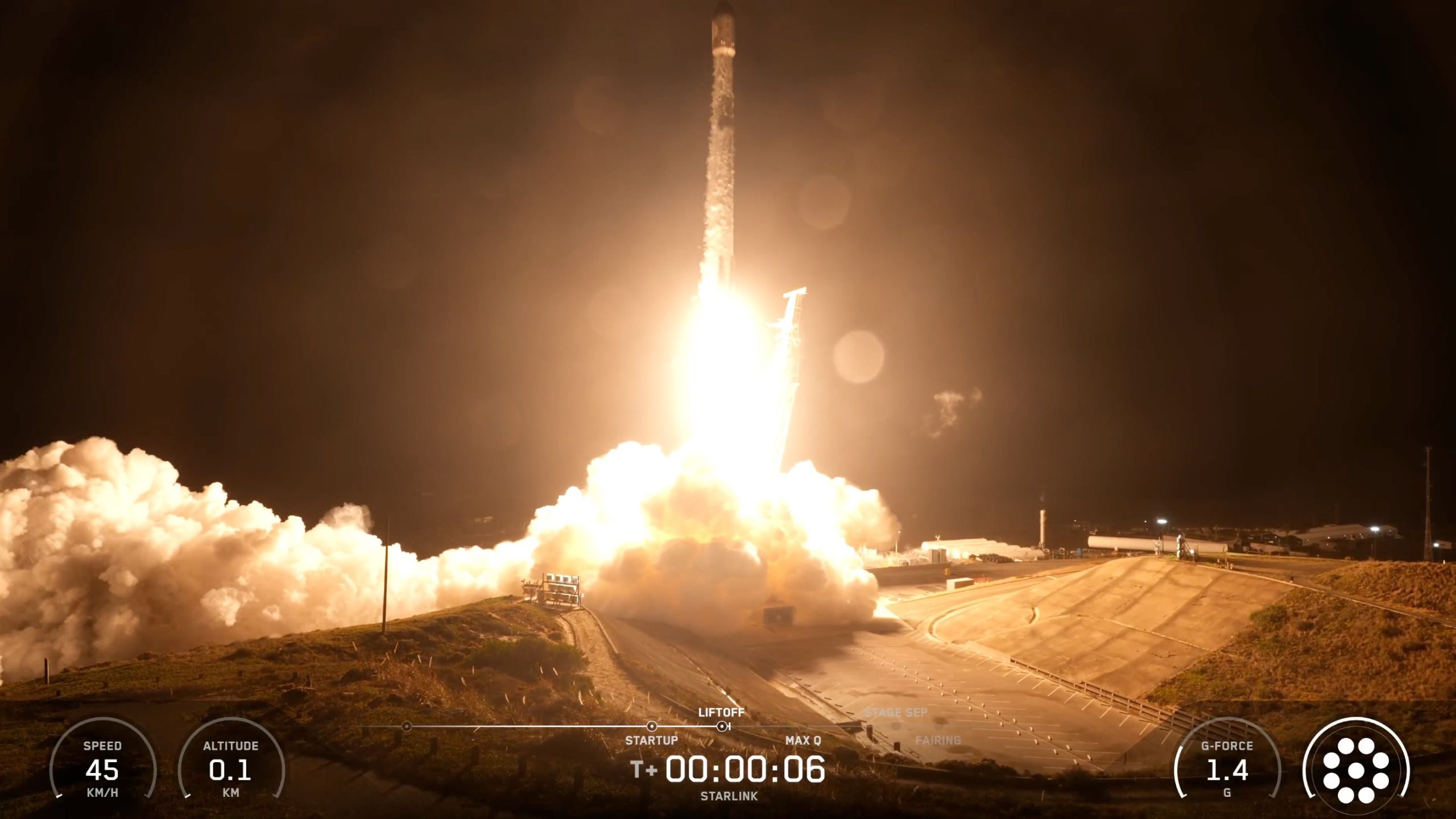
SpaceX sent 27 of its Starlink internet satellites into low Earth orbit with a Falcon 9 launch from Vandenberg Space Force Base in California, according to Space. The rocket lifted off at 12:04 a.m. EDT on Saturday, Oct. 31 — 0404 GMT, which was 9:04 p.m. local time on Friday, Oct. 30.
The first stage returned to Earth roughly 8.5 minutes after liftoff, settling onto the drone ship "Of Course I Still Love You," which was waiting in the Pacific Ocean. Space reports that the booster, designated B1093, was making its 18th flight.
The upper stage released the satellites into low Earth orbit about 62 minutes after launch. They join a Starlink network that now numbers more than 11,000 spacecraft, which Space describes as the largest satellite constellation ever built.
Why it matters
The mission is a routine one by SpaceX's current standards, but it illustrates how far the company's launch cadence has moved. Saturday's flight was the 118th Falcon 9 mission of 2026, and Space reports that more than 70% of this year's Falcon 9 launches have been used to expand Starlink.
That ratio matters beyond SpaceX's own business. Starlink is the revenue engine that funds the company's other programs, and each batch of satellites adds capacity to a network that serves customers around the world. The steady drumbeat of launches also keeps pressure on rival constellation operators and on regulators managing orbital traffic in low Earth orbit.
The launch was also the 72nd flight of 2026 supported by Vandenberg Space Force Base, according to the base. That figure underscores how much of SpaceX's West Coast activity now runs through the California facility.
A booster on its 18th trip
The reuse of B1093 for an 18th flight is notable, though not close to the company's record. Space reports that the mark for a SpaceX first stage is 37 flights, set in August by booster B1067.
Recovering and reflying boosters is central to SpaceX's operating model. Each successful landing on a drone ship removes the need for a new first stage and shortens the turnaround between missions. The droneship "Of Course I Still Love You" has been part of that recovery fleet for years and was positioned in the Pacific for this launch.
The satellites themselves were deployed on schedule, about an hour after liftoff, a sign that both stages performed as planned.
A busy year across the fleet
Falcon 9 has carried most of SpaceX's 2026 workload, but it has not been the only vehicle flying. Space reports that the company has launched Falcon Heavy three times this year and Starship three times as well.
The two programs are at different stages. Falcon Heavy is an operational rocket, while Starship is still in its test-flight phase. SpaceX is preparing for another Starship launch, expected sometime in November, according to Space.
For Starlink users, the practical effect of Saturday's mission is incremental: 27 more satellites in a constellation that already counts more than 11,000. For SpaceX, it is another data point in a year defined by frequency — a launch on Halloween morning that fit neatly into an already crowded manifest.
The next thing to watch is the November Starship flight, which will offer a fresh signal on how quickly the company's next-generation vehicle is maturing alongside the Falcon line.